
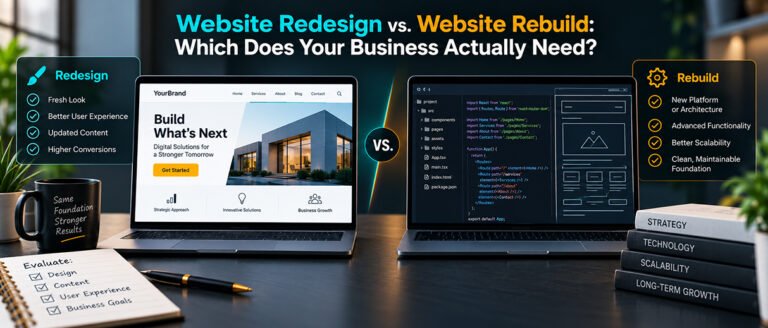
Discover the essential elements of a professional business website, from clear navigation and mobile design to trust signals, content, and CTAs.

A professional business website should clearly explain what the business offers, who it serves, why customers should trust it, and what visitors should do next. Essential elements include clear navigation, mobile friendly design, strong service or product pages, useful content, contact information, trust signals, calls to action, and a structure built around the customer journey.
Your website is often one of the first places potential customers go when they want to learn about your business.
They may arrive after seeing an advertisement, searching on Google, receiving a referral, or hearing about your company from someone they know.
Once they arrive, they need answers quickly.
What does this business do? Is it right for me? Can I trust it? How can I learn more or get started?
A professional business website should make those answers easy to find.
That doesn’t mean every website needs dozens of pages, complicated animations, or an elaborate design. A strong business website is one that combines clear messaging, useful information, intuitive navigation, responsive design, and purposeful calls to action.
The goal is to create a website that supports both the visitor and the business.
A business website is more than an online brochure.
It can serve as a central destination for your brand, services, customer education, lead generation, and online credibility.
A visitor might use your website to:
If important information is difficult to find, visitors may leave before taking the next step.
Citeno’s Web Development service emphasizes fast, conversion optimized websites and landing pages designed around performance and user experience. That reflects an important principle: a business website should have a purpose beyond simply looking good.
Your homepage should quickly communicate the basics of your business.
A visitor should be able to understand:
The first section of the page is especially important because visitors should not have to scroll through several sections before understanding why they are there.
A clear headline, supporting message, and relevant call to action can establish the direction immediately.
Good navigation helps visitors find information without having to think too much about where to click.
A typical business website may include navigation links such as:
The exact structure depends on the business, but the principle remains the same: important information should be easy to find.
Avoid filling the navigation with too many options.
A smaller, well organized menu is often easier for visitors to understand than a complicated collection of links.
Your homepage introduces your business, but individual service or product pages should provide the detail visitors need to make decisions.
A strong service page can explain:
This also creates useful opportunities for search visibility because individual pages can address specific services and customer needs.
Instead of trying to explain every service on one page, give important offerings enough space to communicate their value clearly.
People access websites from many different devices, so your website needs to work properly across screen sizes.
A mobile friendly website should provide:
Content that doesn’t require excessive horizontal scrolling
Mobile usability is not simply a design preference. It is part of creating a website that people can actually use.
A professional website should provide a consistent experience whether someone visits from a desktop computer, tablet, or smartphone.
Visitors should know what they can do next.
A call to action, often called a CTA, guides the visitor toward the next step.
Depending on the business, that could be:
A CTA should match the visitor’s stage in the decision making process.
Someone reading an introductory article may not be ready to buy immediately. A softer action such as reading another resource may make more sense.
On a service page, however, requesting a consultation may be a more appropriate next step.
Visitors naturally want to know whether a business is credible before they contact or purchase from it.
Your website can communicate trust through elements such as:
Customer feedback can provide social proof and show that other people have worked with the business.
Case studies can demonstrate how a business approached real challenges and what was achieved.
An authentic About page can help visitors understand the people behind the company and its experience.
Relevant professional credentials, memberships, certifications, or awards can strengthen credibility when they genuinely apply.
Make it easy for visitors to find legitimate contact information and understand how they can reach the business.
Trust signals should support the actual credibility of the business rather than create artificial impressions.
A professional website should answer the questions customers are likely to have.
That content may include:
The content should be written for the people visiting the website.
For example, instead of filling a service page with technical terminology, explain what the service does, why it matters, what the customer can expect, and how it solves a relevant problem.
Useful content can also create opportunities for search engines to understand the subjects your website covers.
A visitor shouldn’t have to search through multiple pages to figure out how to contact your business.
Your website should provide a clear path to conversion.
Depending on the business, that might include:
The conversion path should also ask for information appropriate to the action.
For example, a simple consultation request may not require a long form with dozens of fields.
The easier you make the appropriate next step, the less friction you create for potential customers.
These elements should not exist as isolated components.
They should work together around the visitor’s journey.
A simple structure might look like this:
Homepage → Service Page → Supporting Content → Trust Signal → Contact or Conversion
For example, a visitor could arrive on the homepage, discover a relevant service, read a case study that demonstrates experience, review supporting information, and then request a consultation.
This is why professional website development involves more than visual design.
The structure, content, navigation, user experience, and conversion path all need to support the same business objective.
Even professionally designed websites can create problems when the underlying strategy is unclear.
Trying to explain everything at once can make the page difficult to navigate.
If visitors cannot quickly understand what you offer, they may not continue exploring.
A visitor may be interested but still leave because there is no obvious next step.
A website that works well on desktop but feels difficult to use on mobile can create unnecessary friction.
Without testimonials, case studies, credentials, or useful company information, visitors may have fewer reasons to feel confident.
Too many menu items can make it harder to find important information.
The solution isn’t necessarily adding more features. In many cases, it is simplifying the experience and giving every element a clear purpose.
Before launching or redesigning a business website, ask:
If several answers are no, the website may need strategic improvements before additional features are added.
A professional business website is a website designed to clearly communicate a company’s offerings, establish credibility, provide useful information, and guide visitors toward relevant actions.
Most business websites benefit from pages such as Home, About, Services, Case Studies or Portfolio, Resources or Blog, FAQs, and Contact. The ideal structure depends on the business.
There is no ideal number. A website should have enough pages to explain important offerings and customer needs without creating unnecessary content.
A homepage should generally communicate what the business does, who it serves, why visitors should care, supporting trust signals, and a clear next step.
Not every business needs a blog, but useful educational content can help answer customer questions, support search visibility, and demonstrate expertise.
Calls to action help visitors understand what to do next, whether that means contacting the business, booking a consultation, viewing a service, or making a purchase.
Yes. A professional website should provide a usable experience across smartphones, tablets, and desktop devices.
Relevant testimonials, case studies, clear company information, credentials, transparent contact details, and useful content can all contribute to a stronger sense of trust.
There is no universal schedule. Websites should be reviewed whenever services, branding, business information, customer needs, or important technology changes.
Design can influence usability, navigation, credibility, and how easily visitors find and act on information. The strongest websites connect design decisions to business and customer goals.
A professional business website doesn’t need to be complicated to be effective.
It needs to be clear, useful, credible, easy to navigate, mobile friendly, and built around a meaningful customer journey.
Start with the fundamentals: explain what you do, make important information easy to find, provide evidence that people can trust your business, and give visitors a clear next step.
From there, your website can become more than an online presence. It can become a useful business asset that supports marketing, customer education, lead generation, and long term growth.
If you’re planning a new website or evaluating an existing one, reviewing these fundamentals can help you identify where improvements may have the greatest impact.
Citeno Marketing develops conversion optimized websites and landing pages designed around performance and user experience, while connecting web development with broader business and marketing goals.

Book a free strategy call and let's talk about your goals.
Book Free Strategy Call