Learn how digital marketing, web development, and branding work together to create a consistent online presence and support business growth.
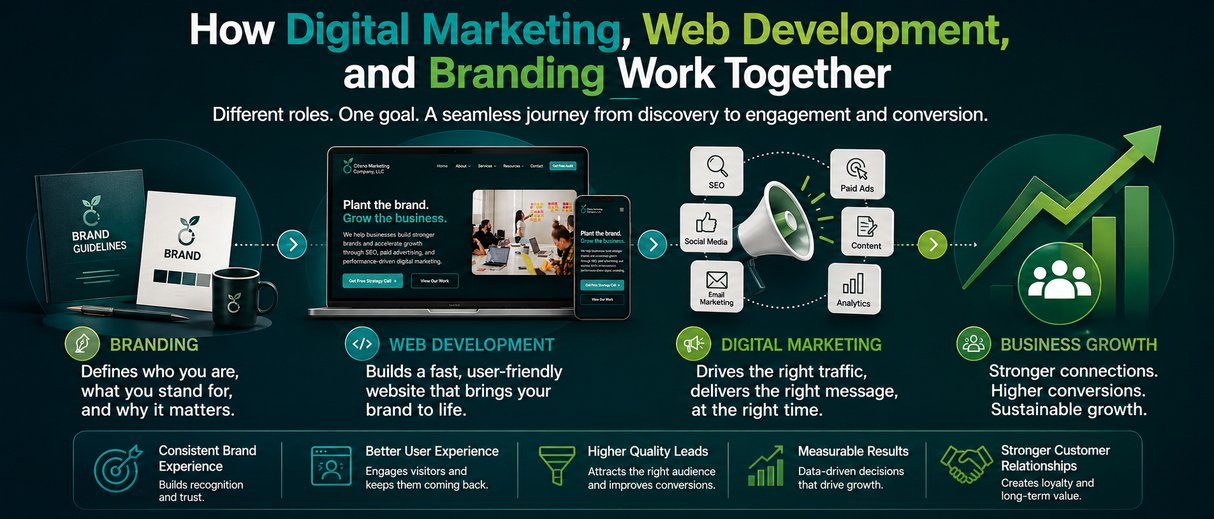
Digital marketing, web development, and branding support different parts of a business’s online presence, but they work best when they move in the same direction. Branding establishes how the business is presented, web development creates the digital experience, and digital marketing brings the right audience to that experience. Together, they can create a more consistent path from discovery to engagement and conversion.
A business can have a strong marketing campaign and still struggle to generate results.
It can have a well designed website but receive very little relevant traffic.
It can also have a recognizable brand but communicate inconsistently across its website, advertisements, and other digital channels.
These situations often happen because the different parts of a company’s digital presence are being treated as separate activities.
Branding, web development, and digital marketing each have a different role. The real opportunity comes from making those roles support one another.
For a growing business, this means thinking beyond individual projects and considering how customers experience the company from their first interaction to the point where they decide to take action.
Before looking at how they connect, it helps to understand what each area contributes.
Brand development helps establish how a business wants to be understood.
It can shape:
A clear brand gives the business a recognizable foundation for communication.
The website is where many digital interactions eventually happen.
A well developed business website should make it easy for visitors to:
Web development therefore turns the brand and business offering into an interactive digital experience.
Digital marketing helps businesses reach people through channels such as:
Its role is not simply to generate traffic.
The goal is to reach the right audience with the right message and move interested people toward a relevant next step.
Imagine a potential customer sees an advertisement for a company.
The advertisement communicates one message.
The person clicks through to the website and sees completely different language and visual elements.
The website then makes it difficult to find the advertised service.
Even if the marketing campaign attracted the right person, the experience has become disconnected.
Now consider the opposite.
The advertisement uses the same core positioning as the website. The visual identity is recognizable. The landing page explains the offer clearly. The visitor finds relevant information and a clear next step.
The individual activities haven’t changed dramatically.
The connection between them has.
That consistency can make the digital journey easier for customers to understand.
Marketing campaigns need something meaningful to communicate.
Brand development can provide that foundation.
For example, if a business has clearly established:
Those ideas can influence advertising messages, content topics, social communication, landing pages, and other marketing activities.
Without a clear brand direction, campaigns can become a collection of individual messages that don’t build toward a recognizable identity.
Branding therefore gives digital marketing a consistent strategic direction.
A website should look and feel like the business it represents.
Brand development can influence:
But branding shouldn’t simply be copied onto a website.
The website needs to translate the brand into an experience.
For example, a premium B2B brand may need a very different website experience from a consumer-focused startup.
The brand establishes the character, while web development turns that character into something visitors can interact with.
Digital marketing can bring people to a website, but the website needs to support what happens after they arrive.
A campaign might generate interest in a specific service.
The corresponding landing page or service page should then provide:
This creates a connection between marketing promise and website experience.
The same principle applies to SEO.
Search visibility can bring visitors to an article or service page, but the website still needs to help those visitors understand the business and find their next step.
A simple customer journey can show how these disciplines interact.
Digital Marketing helps a potential customer discover the business.
This could happen through search, advertising, content, or another digital channel.
Branding helps the customer understand who the business is and what it represents.
Consistent messaging and visual identity can make the company easier to recognize across different interactions.
Web Development provides the environment where the customer can explore the business.
They may review services, case studies, FAQs, or other information.
All three areas contribute.
The marketing message creates relevance, the brand supports confidence and differentiation, and the website makes the next action accessible.
This doesn’t mean every customer follows exactly the same path.
It simply shows why these disciplines are connected rather than isolated.
The three areas don’t always need equal investment at every stage of a business.
However, a major weakness in one area can affect the others.
Marketing may generate visitors, but a confusing website can make it difficult to convert that interest.
A business may have an excellent digital experience but struggle to attract enough relevant visitors.
A business may have a clear identity but fail to communicate it effectively through its website and digital channels.
The lesson isn’t that every business needs to invest heavily in everything at the same time.
It is that the pieces should be capable of supporting one another.
Businesses can use a straightforward framework when planning digital initiatives:
Clarify the audience, positioning, message, and business objectives through brand development.
Create a website and digital experience that communicate the brand and support the customer’s needs.
Use digital marketing to reach people who are likely to benefit from the business’s offering.
Review how visitors interact with the website and how marketing channels perform.
Use what you learn to refine messaging, website experiences, content, campaigns, and other digital activities.
This creates a continuous cycle instead of treating branding, web development, and marketing as unrelated projects.
A new website, new branding, and marketing campaign can each be successful individually but still create a disconnected customer experience.
The wording doesn’t need to be identical everywhere, but the underlying positioning should remain recognizable.
Marketing campaigns should direct visitors to pages that are relevant to what they clicked or searched for.
The website should reflect both the brand and the needs of its intended users.
Getting people to the website is only part of the process. The experience after they arrive matters too.
You don’t necessarily need to rebuild everything at once.
Start by reviewing the current experience.
Ask:
The answers can reveal where the biggest disconnects exist.
From there, businesses can prioritize the areas that need the most attention.
Branding establishes the identity, positioning, and messaging that digital marketing can use to communicate consistently with the target audience.
Digital marketing can attract visitors, while the website provides the experience where those visitors learn about the business and take action.
Yes, but unclear positioning can make it harder for marketing campaigns to communicate a distinctive and consistent message.
Yes. Brand positioning and identity can influence the website’s visual direction, messaging, content structure, and overall experience.
There isn’t one rule for every business, but having a clear brand direction can make digital marketing more consistent and focused.
Relevant landing or service pages can give visitors information that matches the message that brought them to the website, reducing unnecessary friction.
The level of investment can vary, but businesses benefit when their brand, website, and marketing activities support the same goals.
Look for differences in messaging, visual identity, audience targeting, website experience, and calls to action across major customer touchpoints.
Yes. A website is often an important place where customers experience a company’s messaging, identity, credibility, and overall digital presence.
Branding establishes how the business should be represented, while web development translates that direction into a usable digital experience.
Start by making sure campaigns, keywords, content, landing pages, and calls to action are aligned with the audience and message being promoted.
Start by identifying the biggest disconnect between the brand, website, and marketing experience, then prioritize the area that is creating the most friction for customers.
Digital marketing, web development, and branding each solve different business problems.
Branding establishes the direction. Web development creates the digital experience. Digital marketing helps the right people discover it.
When those three areas support the same audience, message, and business goals, the customer experience becomes easier to understand and more consistent.
That doesn’t mean every business needs to invest equally in all three at all times. The priority should depend on the company’s current stage, objectives, audience, and biggest digital challenges.
The important part is making sure that improvements in one area don’t work against the others.
A connected approach gives businesses a stronger foundation for building visibility, recognition, engagement, and long term digital growth.
Citeno Marketing brings digital marketing, web development, and brand development together to help businesses create a more consistent and purposeful digital presence.
Book a free strategy call and let's talk about your goals.
Book Free Strategy Call