

Find out why your business website isn’t ranking on Google and discover practical ways to improve SEO, content, structure, and visibility.
You have a professional website, your services are clearly listed, and your business is ready to attract customers online. Yet when you search Google for the services you offer, your website is nowhere to be found.
This is a common problem for businesses competing for organic visibility. A website can look excellent and still struggle in search because Google needs more than attractive design to determine which pages deserve visibility.
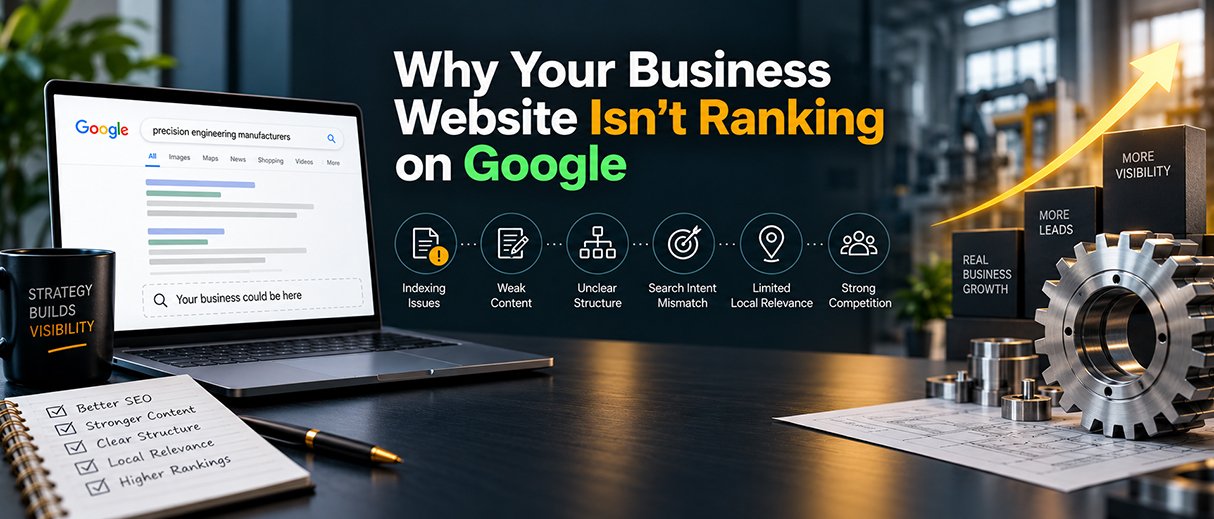
Your website may have indexing problems, weak content, unclear page structure, poor search intent alignment, limited local relevance, or stronger competitors occupying the results you want.
Understanding the reason behind the problem is the first step toward fixing it.
Think about your website from Google’s perspective.
A search engine needs to understand what your business does, which services you provide, who those services are for, and which pages are most relevant to particular searches.
If your website uses vague page titles, generic service descriptions, unclear navigation, or overlapping pages, it becomes harder to establish a clear relationship between your content and specific searches.
For example, a page titled “Our Solutions” provides very little context. A page specifically describing your “Small Business Website Development Services” gives visitors and search engines a much clearer idea of what the page is about.
Clarity should be built into your website from the beginning.
Before trying to improve a page’s ranking, make sure Google can actually discover and index it.
Important business pages can sometimes be affected by technical settings or website problems that are not immediately visible to visitors. A page may have an incorrect noindex directive, a crawl issue, a broken internal connection, a redirect problem, or another technical obstacle.
Start by checking your most important pages, especially:
Google Search Console can help identify indexing and search-performance issues.
If an important page is not available to Google’s index, rewriting the content is unlikely to solve the underlying problem. The technical issue needs to be addressed first.
One of the biggest mistakes businesses make is creating pages around what they want to say instead of what their customers want to know.
Imagine a business that wants to rank for “digital marketing services.”
A page that simply says the company provides “innovative, results-driven digital marketing solutions” does not give a potential customer much useful information.
A better page would explain what the service includes, who it is designed for, which business problems it addresses, how the process works, and what a client should consider before choosing a provider.
Before optimizing a page, ask:
What is someone expecting to find when they search for this topic?
The answer should influence the page’s structure and content.
Your service pages are often some of the most commercially important pages on your website.
Yet many businesses give them less attention than their homepage.
A strong service page should help a potential customer understand the service before they ever contact you.
Consider including information such as:
Avoid filling the page with exaggerated claims or vague marketing language. Specific information gives visitors something useful to evaluate and gives the page a stronger purpose.
The goal is not to make the page as long as possible. The goal is to make it genuinely useful.
A business website should make it easy to understand how different pieces of information connect.
If your business offers multiple services but everything is placed on one broad page, visitors may have difficulty finding the specific solution they need.
A clearer structure could separate major offerings into dedicated pages and connect those pages with relevant supporting content.
For example, educational content about improving online visibility can naturally lead to digital marketing, while an article about creating a better website can introduce web development.
Similarly, content about positioning, messaging, or visual identity can connect to brand development.
This creates a more organized website where important pages support one another instead of operating independently.
Internal linking is more than adding links to random words throughout a blog.
The right internal links help visitors discover related information and make it easier to move through your website.
Suppose someone reads an article about website planning. If that article naturally points them toward a relevant service page, the visitor has an obvious next step.
Review your existing content and ask:
Use natural anchor text and only link when the destination genuinely helps the reader.
Your Website Experience May Be Losing Potential Customers
Search traffic has little value if visitors cannot comfortably use your website.
Open your website on a phone and experience it as someone unfamiliar with your business.
Can you immediately understand what the company does?
Can you find the service you need?
Is the text easy to read?
Can you identify the next step?
Can you complete a contact form without frustration?
Also consider page performance, navigation, layout, and mobile usability. These factors contribute to the overall experience visitors have after arriving from search.
SEO and website experience should work together. Ranking gets someone to the page; a useful website gives them a reason to stay and take action.
If your business serves a particular city or region, your website should communicate that relevance where appropriate.
A local search strategy can involve your Google Business Profile, accurate business information, customer reviews, relevant local mentions, and useful location-focused content.
However, creating dozens of pages with almost identical content and changing only the city name is not a good strategy.
A location page should exist because it provides meaningful information for customers in that area.
Think about what someone in that location would actually want to know before contacting your business.
Sometimes your website is not broken at all. Your competitors may simply be providing a stronger answer.
Search for the terms you want to rank for and study the pages appearing near the top.
Do they answer questions your page ignores?
Do they explain the subject more clearly?
Do they provide stronger examples?
Is their website easier to navigate?
Do they demonstrate more relevant experience?
This type of comparison can reveal opportunities that a standard keyword review may miss.
The objective is not to copy competitors. It is to understand what searchers are being offered and find ways to make your own content more useful.
When a website is struggling in search, avoid changing everything at once.
Start with the pages that matter most to your business. Check whether they can be discovered and indexed. Review the search intent behind the queries you want to target. Improve weak or generic information. Strengthen connections between related pages. Then compare your work against the competing results.
This creates a more practical approach to SEO because every improvement has a reason behind it.
It also makes performance easier to evaluate. If several major changes are made simultaneously, it becomes much harder to understand which improvements actually helped.
Businesses often make SEO more complicated than necessary.
Some common mistakes include:
Good SEO is not about finding a shortcut. It is about making your website easier to understand, more useful to customers, and more competitive for the searches that matter.
Before making major SEO changes, review these areas:
The problem could involve indexing, technical SEO, content quality, search intent, website structure, local relevance, or competition. The first step is identifying which area is limiting visibility.
Google Search Console can help you inspect individual URLs and identify indexing-related issues affecting your website.
Not automatically. Keywords should be used naturally to clarify the topic. Repeating them excessively can make content less useful.
Useful, relevant content helps a page address customer needs and communicate its subject. Quality and usefulness matter more than simply publishing large amounts of content.
Design itself does not guarantee rankings, but poor navigation, difficult mobile experiences, confusing layouts, and other usability problems can weaken the overall website experience.
Relevant links from other websites can contribute to a site’s authority. However, businesses should focus on earning valuable links rather than pursuing quantity or manipulative link-building tactics.
If customers search for businesses or services within a specific geographic area, local SEO can be an important part of generating relevant visibility.
There is no universal timeframe. Results depend on competition, website history, technical condition, content, authority, and the searches being targeted.
They may have a page that better satisfies the searcher’s needs, stronger topical coverage, greater authority, or a more established presence for that subject.
No. Search rankings depend on many variables, including competitors and changes to Google’s search systems. A responsible SEO strategy should focus on sustainable improvements rather than guaranteed positions.
If your website is not generating the visibility or qualified opportunities you expected, adding more keywords is not necessarily the answer.
Citeno Marketing Company can help you evaluate the bigger picture, from your website structure and content to SEO, digital marketing, and the customer journey.
Instead of applying a generic checklist, we focus on identifying where your website may be losing opportunities and what should be improved first.
Ready to turn your website into a stronger growth channel? Talk to Citeno Marketing Company today and start building a strategy around your actual business goals.
Ready to grow? Let’s talk.

Book a free strategy call and let's talk about your goals.
Book Free Strategy Call