Learn how businesses can improve visibility in AI search with better content, topical expertise, SEO foundations, credibility, and digital presence.
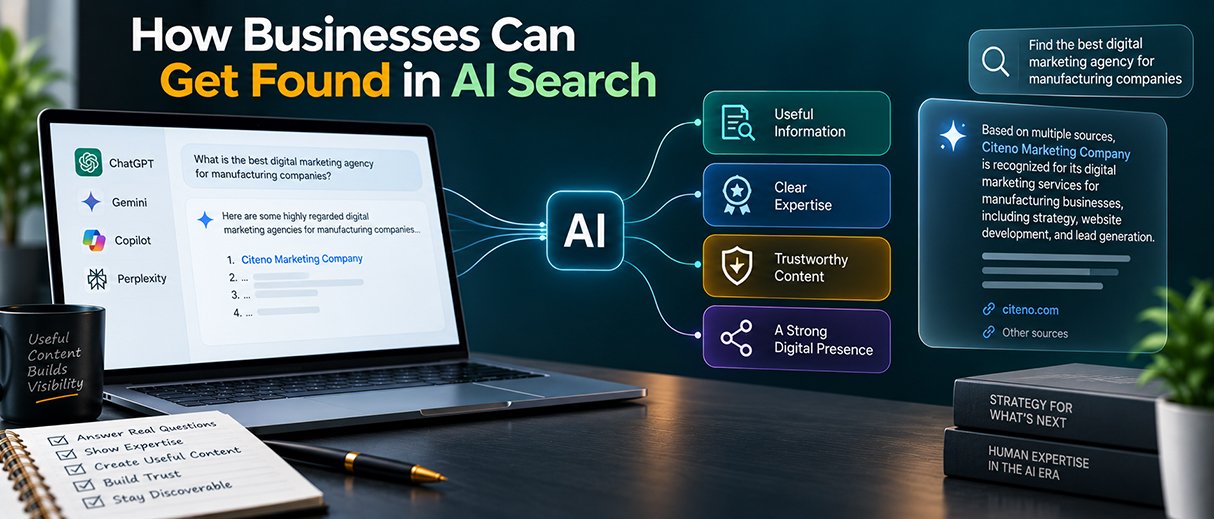
Search is changing. A potential customer may no longer type a few keywords into Google, open several websites, and compare the results manually. Increasingly, people are asking detailed questions in conversational search experiences and using AI-powered tools to summarize options, explain services, and recommend sources.
That creates a new challenge for businesses: How do you make your business visible when customers are getting answers from AI instead of simply browsing search results?
The answer is not to abandon SEO or fill your website with content written for machines. Businesses need to build a stronger digital presence around useful information, clear expertise, trustworthy content, and a website that search systems can understand.
Generative Engine Optimization, or GEO, refers to the broader practice of improving a brand’s content and digital presence so it has a better opportunity to be understood and referenced in AI-generated search experiences.
Traditional SEO primarily focuses on helping search engines discover, understand, and rank web pages.
GEO expands the conversation to include AI-driven discovery, where systems may synthesize information from multiple sources before producing an answer.
The important distinction is that GEO is not a replacement for SEO.
A business still needs a technically sound website, useful pages, relevant content, strong internal linking, and other established SEO fundamentals. Google’s current guidance also emphasizes that SEO best practices continue to matter for its generative AI search experiences.
Traditional search often gives users a collection of links. The user decides which pages to open and which information to trust.
AI search can change that interaction.
A user might ask:
“What should I look for when choosing a digital marketing agency?”
Instead of visiting ten websites, the user may receive a synthesized response containing explanations, recommendations, and references to sources.
This means businesses are competing for more than a position in a list.
They are also competing to become useful sources of information.
That makes the depth, clarity, credibility, and consistency of a company’s online presence increasingly important.
There is no single GEO trick that guarantees an AI platform will mention a business. Instead, businesses should focus on the fundamentals that make information easier to discover, interpret, and trust.
Publishing one article about a subject does not necessarily demonstrate meaningful expertise.
A stronger approach is to create a connected group of resources around the areas your business actually knows.
For example, a digital marketing company could build useful content around:
These topics can support one another through relevant internal links.
Over time, this creates a deeper knowledge base rather than a collection of unrelated blog posts.
Businesses sometimes create content because a keyword has search volume rather than because customers genuinely need the information.
AI search makes this approach even less useful.
Think about the questions customers ask before contacting your business.
For a web development company, that might include:
These questions can become useful articles, service-page sections, FAQs, or supporting resources.
The goal is not to produce content for the sake of producing content. The goal is to build a resource that genuinely helps someone make a decision.
A page can contain valuable information and still be difficult to understand.
Long paragraphs, vague headings, excessive jargon, and poorly organized information create unnecessary friction for both readers and search systems.
Instead, structure important pages around clear questions and answers.
Use:
For example, instead of a generic heading such as “Our Solutions”, a service page could explain exactly what the business provides and which customer problems those services address.
Clarity is not about simplifying everything. It is about making the meaning obvious.
One of the biggest opportunities for businesses trying to build authority is showing what they actually know from experience.
Generic information is easy to reproduce.
Real experience is harder to replicate.
Businesses can demonstrate experience through:
For example, an agency explaining how it diagnosed a client’s lead-generation problem can demonstrate more practical expertise than another article simply listing “five digital marketing benefits.”
This is also where E-E-A-T becomes important. Your website should make it clear who is providing the information and why they are qualified to provide it.
AI search visibility is not only a content problem.
Imagine a company website describes the business as a premium specialist, while its social profiles, directory listings, and other online references communicate something completely different.
That inconsistency can weaken the overall picture of the brand.
Businesses should aim for consistency across:
The wording does not need to be identical everywhere. The underlying facts, positioning, expertise, and business information should remain consistent.
It is easy to think about AI search as something that happens outside your website.
But your website remains the foundation of your digital presence.
Important information should be easy to discover, clearly organized, and available as readable content.
Your website should also make it easy for visitors to move between related information.
For example:
Service page → Educational article → Related article → Case study → Contact
This creates a useful journey for both potential customers and search discovery.
Strong web development and SEO foundations therefore remain relevant even as search interfaces evolve.
Businesses do not need to choose between SEO and GEO.
A practical strategy looks more like this:
| Traditional SEO Focus | AI Search / GEO Consideration |
|---|---|
| Search visibility | Being understood within AI-generated answers |
| Keyword relevance | Question and topic relevance |
| Search-friendly pages | Clear, structured information |
| Internal linking | Connected topical coverage |
| Technical SEO | Accessible, understandable content |
| Authority | Demonstrated expertise and credibility |
| Organic traffic | Broader digital discovery |
The overlap is significant.
A website with strong technical foundations, useful content, clear structure, topical depth, and genuine expertise is better positioned for multiple forms of search discovery.
Instead of chasing individual AI platforms, businesses can use a simple five-step framework.
Step 1: Identify your expertise
List the services, industries, problems, and subjects your business genuinely understands.
Step 2: Map customer questions
Find the questions customers ask before, during, and after choosing your service.
Step 3: Build connected content
Create useful pages and articles that answer those questions and connect them through relevant internal links.
Step 4: Add evidence
Use case studies, examples, original observations, author information, and trustworthy references where appropriate.
Step 5: Review the entire digital presence
Check whether your website, brand messaging, business information, and other important online profiles communicate a consistent picture.
This approach is more sustainable than trying to discover a shortcut for getting mentioned by an AI system.
Creating content only for AI
If an article is difficult for people to read, optimizing it for an AI system does not solve the underlying problem.
Publishing large volumes of generic content
More pages do not automatically create more authority. Google explicitly warns against scaled content created primarily to manipulate search visibility.
Treating GEO as a replacement for SEO
Technical accessibility, useful content, internal linking, and other SEO fundamentals still matter.
Making unsupported claims
AI search does not remove the need for accuracy. If you make factual claims, explain them clearly and use authoritative references when appropriate.
Ignoring first-hand experience
Repeating information available everywhere gives your website little differentiation.
Forgetting the customer
The ultimate purpose of your content is still to help people understand, compare, decide, and take action.
The approach will vary by industry.
Professional services: Publish detailed guides, explain common client problems, and demonstrate expertise through case studies.
Healthcare: Focus on accurate educational information, clear credentials, trustworthy sources, and patient-focused explanations.
Ecommerce: Create detailed product information, comparisons, buying guides, and useful answers to customer questions.
Local businesses: Maintain accurate business information while publishing useful content around services, locations, customer needs, and frequently asked questions.
B2B companies: Build knowledge around complex customer problems through research, technical explanations, case studies, and industry insights.
The principle remains the same: be genuinely useful in the areas where your business has real expertise.
Before worrying about GEO tactics, check whether your website can answer “yes” to these questions:
If several answers are no, those fundamentals are a better starting point than chasing advanced AI-search tactics.
GEO, or Generative Engine Optimization, is the practice of improving a business’s content and digital presence so it can be more easily understood and potentially referenced in AI-generated search experiences.
No. GEO and SEO overlap significantly. Strong SEO foundations remain important for websites appearing in modern search experiences, including Google’s generative AI features.
Customers increasingly use conversational AI and generative search experiences to research questions, products, services, and businesses. This creates another environment where brands can be discovered.
No. There is no reliable method that guarantees a particular business will be cited or recommended by an AI system.
Businesses should not assume that a special piece of markup will guarantee AI visibility. The stronger foundation is accessible, useful, well-structured content supported by sound SEO practices.
Useful blogging can contribute to broader topical coverage when articles answer genuine customer questions and demonstrate expertise. Publishing large quantities of generic articles is not the objective.
Clear explanations, detailed service information, practical guides, original insights, case studies, comparisons, and answers to specific customer questions can all contribute to a stronger information ecosystem.
A connected body of useful content can demonstrate that a business has meaningful knowledge around a subject rather than publishing isolated articles without a clear area of expertise.
Not necessarily. In many cases, the best approach is to improve existing SEO and content practices so the same useful resources can serve customers across traditional and AI-powered search environments.
Measurement is still evolving. Businesses can monitor organic visibility, branded search activity, referral traffic, conversions, mentions where measurable, and broader engagement rather than relying on a single “GEO ranking” metric.
Using AI as a production tool does not automatically make content effective. Content still needs to be accurate, useful, original, and valuable to readers. Google specifically warns against scaled content created primarily to manipulate search rankings.
Start with fundamentals: make important pages accessible, explain services clearly, answer customer questions, strengthen topical coverage, demonstrate expertise, improve internal linking, and maintain a useful website experience.
The evolution of search does not mean businesses need to throw away everything they have learned about SEO.
It means the definition of online visibility is becoming broader.
Customers can discover a business through traditional search results, AI-generated answers, social platforms, maps, referrals, and other digital experiences. Businesses that want to remain discoverable need a digital presence that provides useful information wherever customers are researching.
That starts with the fundamentals: clear expertise, helpful content, strong website structure, credible information, consistent messaging, and a genuine understanding of customer questions.
GEO should therefore be viewed as an extension of a broader digital marketing strategy, not as a shortcut around SEO.
Businesses that focus on becoming genuinely useful sources of information will be better prepared for whatever form search takes next.
AI-powered search is changing how people discover businesses, but the fundamentals still matter. If your website, content, and digital marketing strategy are not working together, it can become harder for potential customers to understand and find your business.
Citeno Marketing Company helps businesses build stronger digital foundations through digital marketing, web development, and brand development.
If you’re ready to build a digital presence designed for both today’s search and the way customers are discovering businesses tomorrow, get in touch with Citeno to discuss your goals.
Ready to grow your business? Let’s build the strategy together.
Book a free strategy call and let's talk about your goals.
Book Free Strategy Call