

Learn why search visibility matters even when customers do not click your website and how US businesses can measure search impact more effectively.
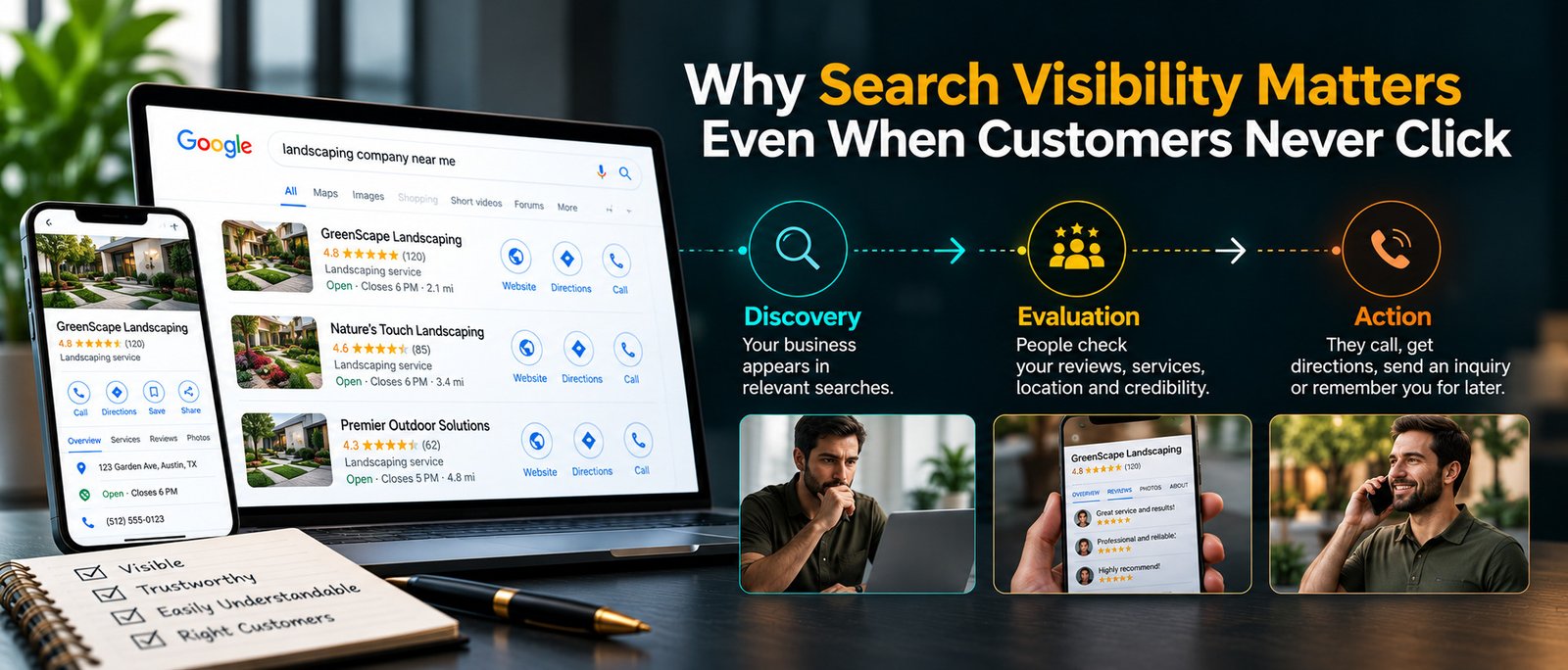
A customer does not always need to visit your website to form an impression of your business.
They may see your company in search results, review your business information, compare you with another provider, check your location, or decide whether your business appears trustworthy. That interaction can influence what they do next, even if no website visit is recorded.
For US businesses, this makes search visibility more than a traffic source. It can also become part of how customers recognize, evaluate, and remember a business.
Search visibility refers to how and where a business appears when people search for information related to its products, services, brand, or location.
A searcher may encounter a business through an organic result, local listing, business profile, review, featured information, or another search feature.
The important point is that visibility can influence a customer before a website click happens.
Website traffic is easy to notice because analytics platforms report visits, sessions, and other activity.
Search exposure is different.
Imagine someone searches for a landscaping company in their area and sees three businesses. They may recognize one name, notice its reviews, remember its service offering, and later contact that business directly.
That customer may never have clicked the company’s website during the original search.
The search interaction still had value.
This is why businesses should avoid judging their entire search presence by website traffic alone.
A business can benefit from appearing in search at different stages of the customer’s decision process.
A person may not know your business yet. Appearing for a relevant search can introduce your company as an option.
Once someone knows about your business, they may look at reviews, services, location, reputation, or other information before deciding whether to move forward.
Eventually, the customer may call, request directions, send an inquiry, visit the business, or return later through a branded search.
The website is important, but it is only one part of this journey.
Search visibility can be particularly important for businesses that depend on local customers.
Consider a dental practice, home service company, restaurant, law firm, or professional service provider.
A potential customer may search for a service and immediately compare several businesses based on what appears in the search experience.
They may look at:
A business that provides clear and trustworthy information can make a stronger first impression before the customer ever reaches its website.
Traffic is still useful. The goal is not to ignore it.
The problem is relying on it as the only indicator of search performance.
Businesses should consider a broader set of signals, including:
Search visibility: Are you appearing for relevant searches?
Branded searches: Are people searching specifically for your business?
Engagement: Are people interacting with your search presence?
Leads and inquiries: Are search users eventually becoming prospects?
Conversions: Are search influenced users taking meaningful actions?
Customer behavior: Are people returning through another channel before converting?
Looking at several signals together provides a more useful picture of marketing performance.
A low click through rate does not automatically mean a search presence is failing.
For some searches, the information a customer needs may already be available without opening a website.
For example, someone may only need to confirm a business’s location or determine whether it provides a particular service.
If the customer already has enough information to take the next step, the lack of a website visit does not necessarily mean the search interaction was worthless.
However, consistently low engagement combined with weak business results deserves investigation.
Search visibility becomes a concern when customers cannot find accurate or useful information about your business.
Warning signs may include:
In these situations, the answer is not simply “get more traffic.”
The business needs to understand why it is not being discovered, considered, or chosen.
Instead of asking only:
“How many people visited our website from search?”
ask:
“How often are potential customers encountering our business, and what happens after they see us?”
That question creates a broader view of search marketing.
It connects visibility with customer behavior rather than treating every search interaction as a simple website visit.
Review your search presence regularly:
If several answers are no, there may be opportunities to strengthen your overall search presence.
No. Traffic is useful, but businesses should also consider visibility, engagement, conversions, leads, and other outcomes connected to their objectives.
Yes. Search exposure can introduce a business, support evaluation, and influence decisions even when the customer does not immediately visit the website.
No. Website traffic remains valuable. It simply should not be treated as the only measure of search performance.
Depending on the search, they may see business information, reviews, locations, services, images, and other details.
No. A customer may find enough information to take another action or remember the business for a later decision.
They should provide accurate business information, maintain a useful website, build relevant content, manage their local presence, and develop trustworthy signals such as genuine customer reviews.
Yes. Branded search activity can provide useful insight into whether people are becoming familiar with and actively seeking the business.
First identify which searches are producing competitor visibility. Then evaluate the differences in relevance, content, local presence, authority, and overall search experience.
Search visibility is not simply a path to website traffic.
For many businesses, search is part of the customer’s first interaction with the brand. A person may discover a company, evaluate its credibility, compare it with competitors, and decide what to do next without immediately clicking through to the website.
That makes the real objective bigger than generating visits.
Businesses need to be visible, understandable, credible, and useful wherever customers encounter them during the search journey.
For US businesses competing for attention online, that broader approach can turn search visibility into a stronger part of the overall digital marketing strategy.
Citeno Marketing Company helps businesses build performance focused digital marketing strategies that connect search visibility, websites, customer journeys, and measurable business outcomes.
If you want to understand whether your current search presence is helping customers discover and choose your business, contact Citeno Marketing Company to discuss your digital marketing goals.


Book a free strategy call and let's talk about your goals.
Book Free Strategy Call