Learn how SEO works, from crawling and indexing to rankings, keywords, content, and technical optimization for long term business growth.
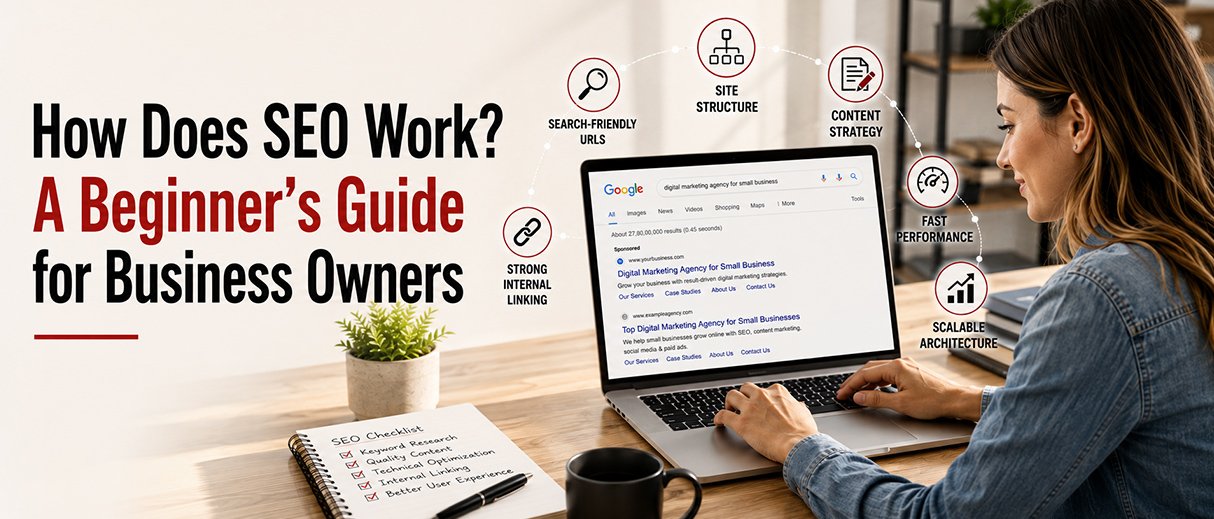
SEO works by helping search engines discover, understand, and evaluate your website so they can show relevant pages to people searching online. For businesses, SEO combines useful content, keyword research, website structure, technical optimization, and other signals to improve organic search visibility and attract relevant visitors.
If you own a business, you’ve probably heard that SEO can help your website appear in Google Search.
But how does SEO actually work?
Search engine optimization can seem complicated because it involves several different areas, including content, keywords, website structure, technical performance, and search intent.
At its core, however, SEO is about helping two groups understand your website:
Search engines need to understand what your pages are about, while potential customers need to quickly understand how your business can help them.
When these two goals work together, SEO can help your business become more visible when people are actively searching for information, products, or services related to what you offer.
Having a website doesn’t automatically mean that people will find it through Google.
Your website may have excellent services, products, or information, but potential customers still need a way to discover those pages.
SEO helps improve your chances of appearing in relevant organic search results.
For example, a local accounting business might want to appear when potential customers search for:
The goal isn’t simply to generate more website traffic.
The goal is to attract relevant traffic from people who may genuinely need your products or services.
That makes SEO different from simply increasing the number of visitors to a website.
To understand SEO, it helps to understand the basic process search engines use to organize information on the web.
Search engines use automated programs called crawlers to discover web pages.
These crawlers follow links and discover new pages or changes to existing pages.
If search engines cannot properly access important pages on your website, those pages may have difficulty appearing in search results.
After discovering a page, a search engine can analyze and store information about it in its index.
You can think of a search engine’s index as a huge library containing information about webpages.
Being indexed is important, but it doesn’t automatically mean that a page will rank highly.
When someone searches for something, search engines evaluate available pages and determine which results are most relevant and useful for that particular search.
This is where SEO becomes important.
Rather than trying to manipulate search engines, businesses should focus on creating pages that clearly address their audience’s needs and provide useful information.
SEO is not one single activity. It involves several areas that work together.
Keyword research helps businesses understand what their potential customers search for.
For example, someone looking for digital marketing help might search for:
However, choosing keywords isn’t only about search volume.
Search intent matters.
Someone searching for “what is SEO” is looking for educational information.
Someone searching for “SEO agency for small business” may be looking for a service provider.
Understanding this difference helps businesses create the right type of page for the right search.
On page SEO focuses on elements that appear on your website.
These can include:
The objective is to make each page clear and useful for both visitors and search engines.
A page should have a clear purpose and provide enough information to satisfy the search behind the query.
Technical SEO focuses on the website’s underlying structure and accessibility.
It can include:
Technical SEO creates the foundation that allows search engines to access and understand your website effectively.
Content gives search engines and users information about what your website covers.
For businesses, this can include:
Good content should answer genuine questions and solve real problems rather than simply repeating keywords.
Google’s guidance emphasizes creating helpful, reliable, people-first content rather than content created primarily to manipulate search rankings.
A small business doesn’t need to optimize everything at once.
A simple approach can start with understanding the audience and building a strong website foundation.
Identify who you want to reach and what they need.
Think about the questions they ask before purchasing your product or service.
Find the words, questions, and topics your potential customers use when searching online.
Look beyond individual keywords and understand the intent behind those searches.
Review your main service, product, and informational pages.
Make sure each page has a clear topic, useful content, logical headings, and an understandable URL.
Build educational content around relevant questions your audience is asking.
Over time, this can help your website establish greater depth around important topics.
Make sure search engines can access important pages and that visitors can use the website effectively across devices.
Monitor organic search performance and identify which pages and topics are gaining visibility.
SEO is an ongoing process rather than a one-time website task.
Keywords are useful, but repeatedly using the same phrase does not automatically improve a page.
The content still needs to answer the user’s question.
Publishing large numbers of unrelated articles doesn’t necessarily create authority.
Each article should have a clear audience, search intent, and purpose.
Content is important, but technical accessibility, website structure, mobile usability, and navigation also matter.
SEO generally requires consistent effort and measurement.
Competition, website history, content quality, industry, and many other factors can influence how quickly visibility develops.
A page should ultimately help the person reading it.
If content is difficult to understand or provides little value, adding more keywords won’t solve the underlying problem.
A strong SEO foundation starts with a few simple principles:
The objective is not simply to rank higher.
The objective is to make your website more discoverable, understandable, useful, and trustworthy.
Before publishing or optimizing a page, ask:
SEO is the process of improving a website so search engines can understand its content and people can discover relevant pages through organic search.
Small business SEO involves understanding customer searches, optimizing website pages, creating useful content, and improving the website’s technical foundation over time.
There is no fixed timeline. Results can depend on competition, website authority, content quality, technical condition, search demand, and consistency.
No. SEO can improve search visibility, but no legitimate strategy can guarantee a specific ranking position.
On page SEO involves optimizing website elements such as content, headings, titles, URLs, internal links, and images.
Technical SEO focuses on the technical aspects that help search engines access, crawl, understand, and index a website.
A blog isn’t mandatory, but useful educational content can help businesses answer customer questions and build topical depth.
Businesses can handle many basic SEO activities themselves. More complex websites and competitive industries may benefit from professional SEO support.
SEO keywords are words and phrases people use when searching for information, products, or services online.
SEO and paid advertising serve different purposes. SEO focuses on organic visibility, while paid advertising provides paid placements. Many businesses can benefit from using both.
Website design can influence navigation, usability, mobile experience, accessibility, and site structure, all of which contribute to creating a better website experience.
SEO doesn’t have to be mysterious.
At its foundation, it is about helping search engines understand your website while making your content genuinely useful to the people you want to reach.
For business owners, the process starts with understanding your audience and the searches they make. From there, you can build useful pages, create relevant content, improve your website’s technical foundation, connect related information, and measure the results.
SEO is a long term process, but building the right foundation early can help create sustainable organic visibility as your website and content library grow.
If you’re unsure where your website currently stands, an SEO audit can help identify technical issues, content opportunities, and areas where your search visibility can improve.
Citeno Marketing helps businesses connect digital marketing, web development, and brand development to create a stronger foundation for long term growth.


Book a free strategy call and let's talk about your goals.
Book Free Strategy Call