
Discover why a connected digital marketing strategy delivers better results than isolated campaigns. Learn how integrating websites, branding, SEO, and digital marketing helps businesses achieve sustainable growth.
Businesses have more ways than ever to reach potential customers. Search engines, paid advertising, email marketing, websites, and social media all influence how buyers discover, evaluate, and choose a business. Despite having access to these channels, many companies still manage each one independently, expecting individual campaigns to deliver long term growth.
Today’s B2B buyers do not make purchasing decisions after a single interaction. They research solutions, compare providers, explore websites, read industry content, and revisit brands several times before contacting a sales team. If your marketing channels are disconnected, these interactions can feel inconsistent, making it harder to build trust and convert prospects into customers.
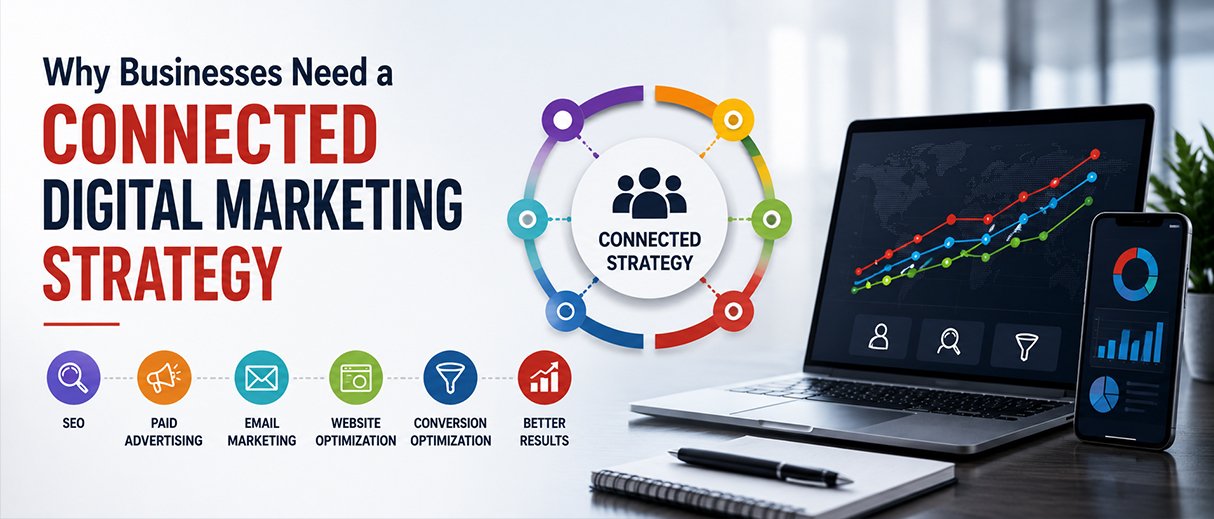
A connected digital marketing strategy brings every channel together under one business objective. Instead of treating SEO, paid advertising, email marketing, and website optimization as separate activities, they work together to create a seamless customer journey that generates qualified leads and supports sustainable revenue growth.
Many businesses invest in SEO, paid advertising, email campaigns, or social media marketing without connecting these efforts through a unified strategy. While each channel can produce results independently, they often fail to deliver their full potential when they operate in isolation.
Consider a business running successful Google Ads campaigns that drive visitors to its website. If the landing page is outdated, the messaging differs from the advertisement, or there is no follow up communication after a visitor leaves, valuable opportunities are lost. The same challenge exists when a business ranks well in search engines but fails to provide clear calls to action or relevant content that encourages visitors to engage.
Disconnected marketing efforts commonly lead to:
Bringing every marketing activity together under a shared strategy allows each channel to strengthen the next, creating a smoother experience for potential customers and improving business outcomes.
Business buyers rarely move directly from discovering a company to making a purchase. Instead, they interact with multiple digital touchpoints while researching their options.
A typical customer journey may include:
Each interaction shapes the buyer’s perception of your business. When messaging, branding, and user experience remain consistent across every touchpoint, prospects feel more confident moving forward.
Effective digital marketing is about creating a connected system rather than managing isolated campaigns.
Search engine optimization helps potential customers discover your business through relevant searches. Paid advertising expands your reach among audiences actively looking for solutions. Email marketing helps businesses stay connected with prospects by delivering relevant information at every stage of the decision making process. Your website provides the information buyers need to evaluate your expertise, while analytics reveal how customers interact with every stage of their journey.
When every marketing channel supports a shared objective, businesses deliver a more consistent experience and achieve better results from their overall marketing efforts. Instead of competing for budget or attention, every marketing activity contributes to attracting, engaging, and converting qualified leads.
Search engine optimization helps businesses become visible when potential customers are actively researching solutions. By attracting qualified visitors with genuine interest, SEO creates opportunities for sustainable growth that continue long after individual campaigns have ended.
SEO becomes even more valuable when it supports a broader digital marketing strategy. Educational blog articles answer common customer questions, optimized service pages target commercial search intent, and valuable resources encourage visitors to take the next step.
Rather than measuring SEO only by rankings or website traffic, businesses should evaluate how organic search contributes to qualified leads, customer engagement, and revenue generation. When SEO aligns with content marketing, website optimization, and lead nurturing, it becomes an important driver of long term business success.
Paid advertising can quickly introduce your business to the right audience, but long term success depends on what happens after visitors arrive on your website.
Many businesses focus heavily on generating traffic without considering the visitor experience after the click. Slow websites, confusing landing pages, inconsistent messaging, or lengthy contact forms often prevent interested prospects from taking action.
A connected marketing strategy ensures that advertising campaigns direct visitors to relevant landing pages, educational resources, and clear calls to action that match their intent.
As a result, businesses generate more value from every advertising dollar by encouraging a higher percentage of visitors to take meaningful action.
Successful marketing strategies are built on measurable insights rather than assumptions.
Businesses can learn valuable information from website analytics, CRM platforms, advertising reports, and customer behavior data. These insights reveal which marketing channels attract qualified leads, where prospects leave the buying journey, and which campaigns contribute most to revenue.
Instead of focusing only on impressions or clicks, businesses should measure success using metrics such as:
Using data to guide marketing decisions helps businesses continuously improve performance while investing in the strategies that produce meaningful business results.
Driving visitors to your website is only part of the equation.
The ultimate goal is to encourage more website visitors to become qualified leads and long term customers.
Conversion Rate Optimization, commonly known as CRO, focuses on improving every aspect of the user experience so visitors can complete important actions with confidence. Faster page loading, intuitive navigation, compelling calls to action, and simplified forms all contribute to higher conversion rates.
Small improvements often create significant business impact because they increase the value of the traffic you already receive rather than relying solely on larger advertising budgets.
Digital marketing is most effective when every channel works toward the same objective.
SEO attracts qualified visitors, paid advertising expands visibility, email marketing strengthens relationships, website optimization improves user experience, and CRO helps convert more opportunities into customers. Together, these efforts create a connected marketing system that supports every stage of the customer journey.
Instead of asking which marketing channel performs best, businesses should focus on how each channel contributes to a unified strategy. When every digital touchpoint works together, marketing becomes more efficient, customer experiences improve, and business growth becomes easier to measure.
Companies that invest in a connected B2B digital marketing strategy are better positioned to generate qualified leads, improve conversion rates, maximize marketing investments, and build lasting relationships with their customers in an increasingly competitive marketplace.
A connected digital marketing strategy combines SEO, paid advertising, email marketing, website optimization, content marketing, and analytics into one coordinated system that supports business goals and creates a consistent customer experience.
B2B buyers interact with multiple channels before making a purchasing decision. An integrated strategy ensures every touchpoint delivers consistent messaging, helping businesses build trust, generate qualified leads, and improve conversion rates.
SEO helps businesses attract potential customers who are actively searching for products or services. When combined with valuable content, optimized landing pages, and lead nurturing, SEO contributes to long term lead generation and business growth.
Conversion Rate Optimization is the process of improving website pages, user experience, and calls to action so that more visitors complete valuable actions such as submitting a contact form, requesting a consultation, or making a purchase.
Rather than focusing only on website traffic or clicks, businesses should track qualified leads, conversion rates, customer acquisition costs, return on marketing investment, and revenue generated to understand the true impact of their marketing efforts.

Book a free strategy call and let's talk about your goals.
Book Free Strategy Call