
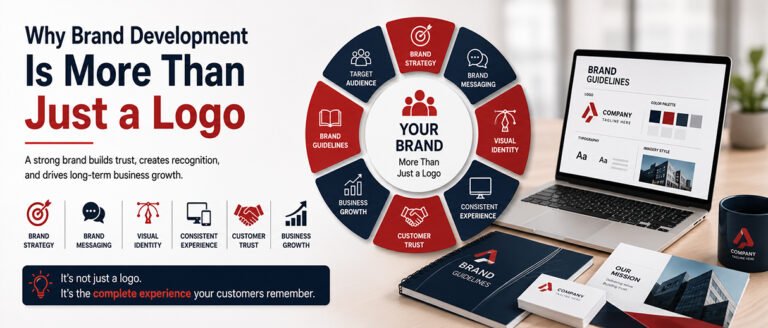
Learn what brand development means, how the process works, and how businesses can build a clear, consistent, and recognizable brand.
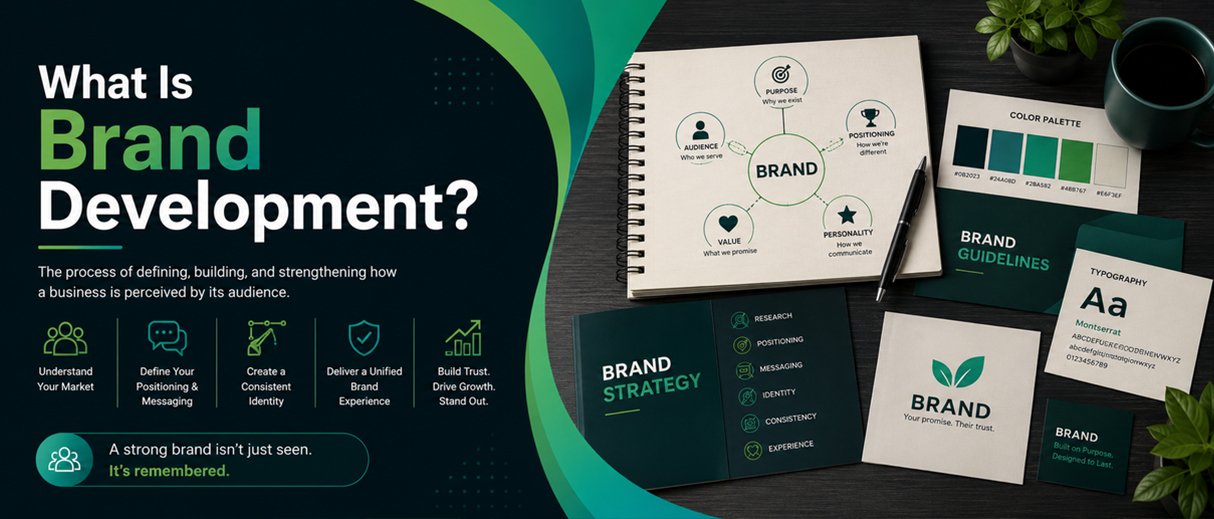
Brand development is the process of defining, building, and strengthening how a business is perceived by its audience. It involves understanding the target market, establishing positioning and messaging, developing a consistent identity, and creating experiences that reinforce what the business stands for.
A business can have a good product or service and still struggle to stand out.
Customers have more choices than ever, and many businesses compete for attention in the same channels. In that environment, simply being visible isn’t always enough.
People need to understand who your business is, what it offers, what makes it different, and why they should remember it.
That’s where brand development comes in.
Brand development gives businesses a structured way to shape how they present themselves and how they want to be understood by their audience.
It isn’t about creating a visual identity in isolation. It is about bringing together positioning, messaging, identity, consistency, and customer experience into a recognizable brand.
A strong brand can make a business easier to recognize and easier to understand.
Consider two companies offering similar services. One communicates a clear position, uses consistent messaging, presents a recognizable identity, and creates a similar experience across its website and marketing channels.
The other changes its messaging frequently, uses inconsistent visuals, and communicates differently across platforms.
Even if both companies provide similar services, the first may create a stronger impression.
Brand development helps businesses create that consistency intentionally.
It can help with:
A brand is developed over time through repeated interactions, not through a single design decision.
Brand development should begin with the people the business wants to reach.
A business needs to understand:
Without this understanding, branding can become based on what the business wants to say rather than what its audience needs to hear.
The audience should influence the language, positioning, messaging, and overall experience.
Positioning explains where a business wants to sit in the minds of its target customers.
A useful positioning framework considers:
For example, two digital agencies may offer similar services but position themselves differently. One may focus on enterprise businesses, while another may focus on growth-stage companies.
The services may overlap, but the positioning creates a different market perception.
Once positioning is clear, businesses need to communicate it consistently.
Brand messaging can include:
The objective is not to repeat the exact same sentence everywhere.
Instead, the underlying message should remain consistent while being adapted to different audiences and channels.
Brand identity is the collection of visual and verbal elements a business uses to represent itself.
It can include:
The important point is that these elements should work together.
A brand identity should reflect the positioning and personality established earlier rather than being selected without strategic context.
Consistency helps people recognize a business across different touchpoints.
A potential customer might encounter a company through:
Google → Website → LinkedIn → Advertisement → Sales conversation
If the business looks and sounds completely different at each stage, the experience can feel disconnected.
Consistent branding doesn’t mean every platform needs identical content.
It means the core identity, positioning, messaging, and overall character remain recognizable.
There is no single process that every business must follow, but a practical framework can look like this:
Study the target audience, competitors, market, existing customer perceptions, and current brand presence.
Establish positioning, audience, differentiation, values, personality, and core messaging.
Translate the strategy into visual and verbal elements that consistently represent the business.
Use the identity across relevant customer touchpoints, including the website, social channels, marketing materials, presentations, advertising, and other communications.
Brand development doesn’t necessarily end when the identity is launched.
Businesses grow, markets change, and customer expectations evolve. Periodic reviews can help determine whether the brand still represents the business effectively.
These terms are related, but they aren’t exactly the same.
TABLE
A brand identity can be an important part of brand development, but brand development covers a wider strategic process.
Jumping directly into colors and logos without understanding the audience and positioning can result in an identity that looks good but lacks strategic direction.
A brand that attempts to speak to everyone can struggle to communicate a distinctive position.
Frequent changes in positioning or communication can make it harder for audiences to understand what the business represents.
Using different visual styles, tones, and messages across channels can weaken recognition.
Competitor research is useful, but a brand should not simply imitate another company’s identity.
Brand perception is influenced by interactions with the business, not only by marketing materials.
Businesses developing or refining their brand should:
The goal is to make the brand easier to recognize, understand, and remember.
Imagine a growing B2B technology company that initially presents itself as a general software provider.
As the company grows, it discovers that its strongest customers are mid-sized businesses looking for specialized automation solutions.
The company could refine its brand development strategy by:
The result isn’t simply a new visual identity.
The business now has a clearer answer to who it serves, what it stands for, and why it is relevant.
Before launching or refining a brand, ask:
Brand development is the ongoing process of defining, building, communicating, and strengthening how a business is understood and perceived by its target audience.
Brand development is the broader process of building and strengthening a brand. Branding can refer to the activities and elements used to shape and communicate that brand.
It can include audience research, positioning, differentiation, messaging, identity development, brand guidelines, and consistent application across customer touchpoints.
There is no fixed timeline. It depends on the size of the business, complexity of the market, research requirements, number of stakeholders, and scope of the project.
No. Businesses of different sizes can benefit from clearer positioning, messaging, and consistent brand presentation.
Consistency makes it easier for customers to recognize and understand a business across different interactions and marketing channels.
Brand positioning describes how a business wants to be understood in relation to its target audience and competitors.
Brand identity can include visual elements such as logos, colors, typography, imagery, and verbal elements such as tone of voice and messaging.
Yes. Businesses may refine or reposition their brand when their audience, services, market position, or growth strategy changes.
A clear brand can give marketing teams stronger positioning, messaging, and visual direction, making communication more consistent across campaigns and channels.
Startups can benefit from establishing a clear audience, position, message, and identity early, especially when they are entering a competitive market.
There is no universal schedule. A brand should be reviewed when the business, market, audience, or strategic direction changes significantly.
Brand development is the process of building a clear and recognizable identity around a business and making sure that identity remains meaningful to the people it wants to reach.
It starts with understanding the audience and defining a clear position. From there, businesses can develop their messaging, identity, and guidelines and apply them consistently across relevant customer experiences.
The strongest brands aren’t simply recognizable. They are understandable, differentiated, consistent, and supported by the experience customers actually receive.
If your business has grown, entered a new market, changed its services, or struggles to communicate what makes it different, it may be time to evaluate your brand development strategy.
Citeno Marketing helps businesses develop stronger brands by connecting strategic positioning, messaging, identity, and digital experiences into a more consistent brand presence.

Book a free strategy call and let's talk about your goals.
Book Free Strategy Call