

Users are moving away from traditional Google searches to discover brands on Instagram, YouTube, and TikTok. Learn how to optimize your content for social SEO.
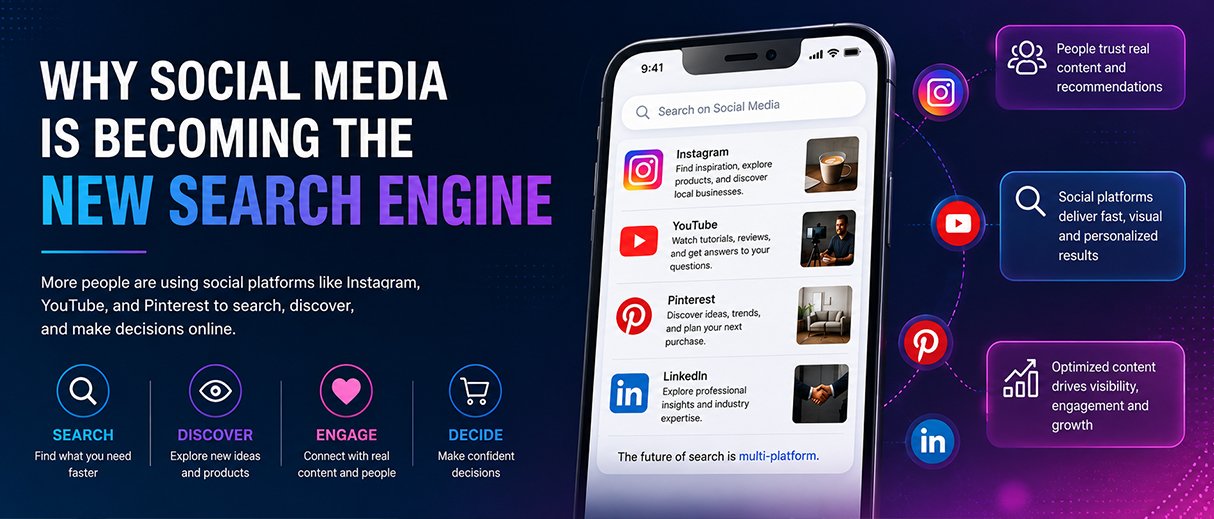
In the past, consumers relied almost entirely on Google to discover businesses, products, and services online. Today, that behavior is rapidly changing. Instead of relying only on traditional search engines, many users now turn to platforms like Instagram, YouTube, and Pinterest to explore products, discover brands, find tutorials, and research local businesses.
This shift is transforming the way brands approach digital marketing.
Social media is no longer just about engagement and visibility. It now plays a major role in how people search, discover, and make buying decisions online.
For businesses, this means one thing: if your content is not optimized for social search, you could be missing valuable opportunities to reach your audience.
Search behavior has evolved significantly over the last few years. Instead of typing every question into Google, users are increasingly turning to social platforms for fast, visual, and personalized answers.
For example:
People often trust real content from creators, businesses, and communities more than traditional search results because it feels authentic, visual, and easier to consume.
There are several reasons social media platforms are becoming powerful discovery tools for consumers.
Users can instantly watch demonstrations, tutorials, reviews, or customer experiences instead of reading long web pages.
For example, someone searching for:
may prefer visual content and short videos over traditional search listings.
Social media algorithms recommend highly relevant content based on user behavior, interests, and engagement patterns.
This creates a more personalized experience compared to traditional search engines.
Consumers are increasingly influenced by authentic content, customer experiences, behind-the-scenes videos, and creator recommendations.
Authenticity plays a major role in modern purchasing decisions.
Businesses can no longer rely only on traditional SEO strategies.
While Google search optimization is still important, brands must also optimize content for social discoverability.
Companies that adapt early to social search trends can improve:
Ignoring social search could make it harder for businesses to stay visible in competitive industries.
Social Media SEO refers to optimizing your social content so it can be discovered through platform searches and recommendation algorithms.
This includes:
Social platforms now analyze keywords, engagement signals, captions, and user behavior to determine which content appears in search results and recommendations.
Instagram is no longer driven only by hashtags.
The platform now uses keywords in:
This means businesses should create content around topics people are actively searching for.
For example, a marketing agency may create posts around:
Using relevant keywords naturally can improve discoverability across Instagram search.
YouTube remains one of the most powerful discovery platforms online.
People use YouTube to:
Both long-form and short-form videos play an important role in modern search behavior.
For brands, YouTube content can help build authority, improve visibility, and drive long-term traffic.
Businesses should start treating social media content with the same level of strategy used for traditional SEO.
Here are a few ways brands can improve social discoverability:
Create content around topics your audience is actively searching for.
Instead of posting random promotional content, focus on educational and problem-solving content.
Include relevant keywords in:
Avoid keyword stuffing. The goal is to create content that feels natural and informative.
Video continues to dominate social engagement and discoverability.
Short-form video content performs especially well across:
Consistency helps improve visibility across social platforms.
Businesses that consistently publish valuable content are more likely to appear in recommendations and search results.
Likes, comments, shares, saves, and watch time all influence discoverability.
Creating engaging content can significantly improve reach.
Google is still an essential part of digital marketing, but it is no longer the only place consumers search for information.
Today’s customers move across multiple platforms before making decisions.
A user may:
This multi-platform journey means businesses need an integrated digital marketing strategy.
Brands that optimize for both traditional SEO and social search will have a stronger competitive advantage.
Social media platforms are rapidly evolving into modern discovery engines.
Consumers now expect fast, visual, authentic, and personalized content experiences. Businesses that adapt to these changing search behaviors can improve visibility, attract new audiences, and build stronger customer relationships.
As social search continues to grow, brands should focus on creating searchable, valuable, and engaging content across every major platform.
The businesses that embrace social media SEO early will be better positioned for long-term digital growth.
Book a free strategy call and let's talk about your goals.
Book Free Strategy Call